Why Website Mobile Site Speed Matters Complete Guide for 2025
Why Website Mobile Site Speed Matters: Complete Guide for 2025
In 2025, a staggering 58.67% of all global web traffic comes from mobile devices. Yet, despite this mobile-dominated landscape, countless businesses still treat mobile speed as an afterthought. This oversight costs them dearly—in search rankings, customer conversions, and revenue.
Mobile site speed refers to how quickly your website loads and becomes fully interactive on smartphones and tablets. It’s not just about convenience anymore; it’s about survival in an increasingly competitive digital marketplace where users expect lightning-fast experiences and search engines reward sites that deliver them.
This comprehensive guide reveals why mobile site speed has become the ultimate differentiator for businesses seeking growth in 2025. From Google’s evolving algorithms to user behavior shifts, we’ll explore how fast mobile performance directly impacts your bottom line and provide actionable strategies to optimize your site for maximum speed and conversions.
Key Takeaways
• Mobile speed directly impacts SEO rankings through Google’s Core Web Vitals and mobile-first indexing approach • Every second of delay costs conversions—mobile users abandon sites that take longer than 3 seconds to load • Technical optimization strategies like image compression, code minification, and CDN implementation can dramatically improve mobile performance • Measuring and monitoring mobile speed using tools like PageSpeed Insights and Core Web Vitals reports is essential for ongoing success • ROI from mobile speed optimization often exceeds 200% through improved search visibility and conversion rates
The Current Mobile Landscape
Mobile-First Reality 📱
The digital landscape has fundamentally shifted. Mobile devices now generate more web traffic than desktop computers, tablets, and other devices combined. This isn’t just a trend—it’s the new reality that shapes how businesses must approach their online presence.
Current mobile usage statistics paint a clear picture:
Mobile traffic accounts for 58.67% of global web traffic
Mobile e-commerce sales represent 72.9% of total e-commerce sales
91% of mobile users access the internet daily
Mobile searches have grown by 61% year-over-year
Google recognized this shift early and implemented mobile-first indexing in 2021. This means Google primarily uses the mobile version of your website for indexing and ranking purposes. If your mobile site is slow, poorly optimized, or lacks content compared to your desktop version, your search rankings suffer across all devices.
User behavior on mobile devices differs significantly from desktop usage. Mobile users are typically:
More impatient and task-oriented
Multitasking while browsing
Using touchscreen interfaces that require responsive design
Dealing with varying network conditions from 3G to 5G
Speed Expectations in 2025 ⚡
User attention spans have shortened dramatically. The famous “3-second rule” has become even more critical in 2025. Research shows that:
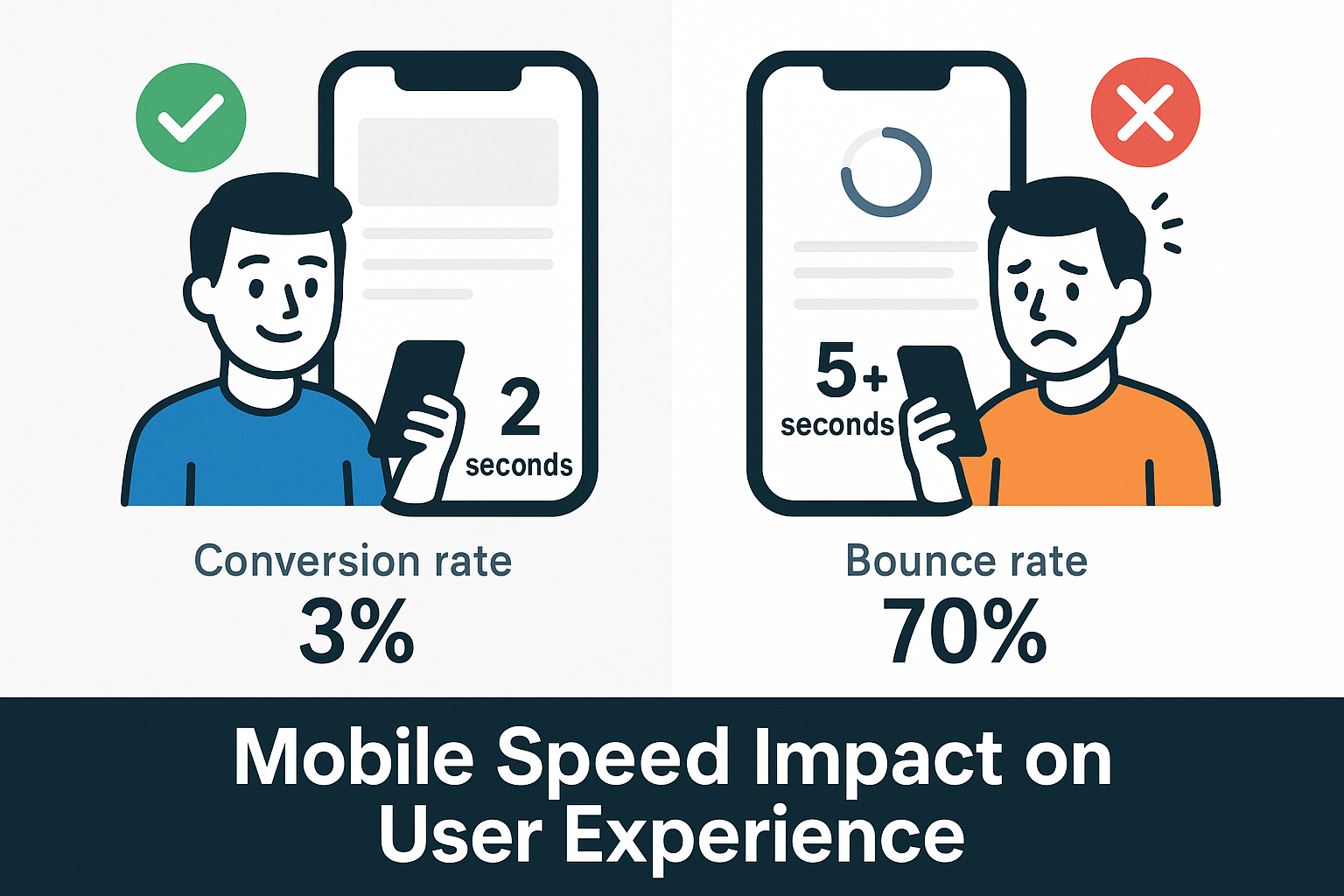
53% of mobile users abandon sites that take longer than 3 seconds to load
40% of users expect pages to load in 2 seconds or less
Each additional second of load time increases bounce rates by 32%
Industry benchmarks for mobile load times have become increasingly stringent:
| Industry | Target Load Time | Acceptable Range | |————–|———————|———————| | E-commerce | 1-2 seconds | Under 3 seconds | | News/Media | 1-3 seconds | Under 4 seconds | | SaaS/Tech | 1-2 seconds | Under 3 seconds | | Local Business | 2-3 seconds | Under 4 seconds |
These expectations continue to rise as network infrastructure improves and users become accustomed to faster experiences from major platforms like Google, Amazon, and social media sites.
SEO Impact of Mobile Site Speed
Google’s Core Web Vitals 🎯
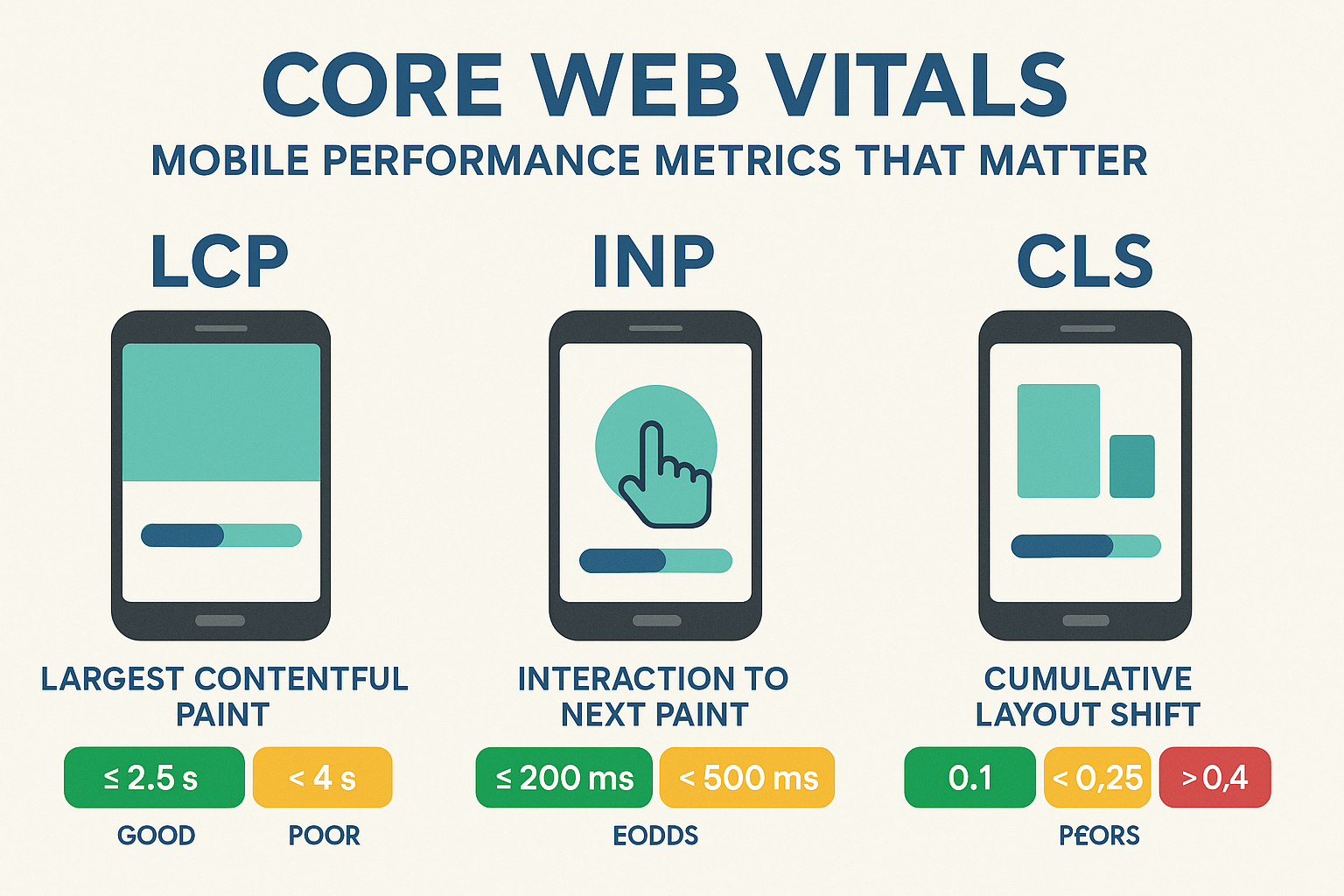
Google’s Core Web Vitals have revolutionized how search engines evaluate mobile site speed. These metrics became official ranking factors in 2021 and continue to gain importance in 2025. Understanding and optimizing for these metrics is crucial for maintaining competitive search visibility.
Largest Contentful Paint (LCP) measures loading performance. It marks the point when the largest content element becomes visible to users. For optimal user experience:
Good: 2.5 seconds or faster
Needs Improvement: 2.5-4.0 seconds
Poor: Longer than 4.0 seconds
LCP directly correlates with user perception of page speed. When users see the main content quickly, they’re more likely to stay engaged and complete desired actions.
Interaction to Next Paint (INP) replaced First Input Delay in 2024 and measures responsiveness throughout the entire page lifecycle. It assesses how quickly a page responds to user interactions:
Good: 200 milliseconds or less
Needs Improvement: 200-500 milliseconds
Poor: Longer than 500 milliseconds
This metric is particularly important for mobile users who rely on touch interactions and expect immediate feedback when tapping buttons, links, or form fields.
Cumulative Layout Shift (CLS) measures visual stability by quantifying unexpected layout shifts during page loading:
Good: 0.1 or less
Needs Improvement: 0.1-0.25
Poor: Greater than 0.25
Mobile users are especially sensitive to layout shifts because they often cause accidental taps on wrong elements, leading to frustration and abandonment.
Mobile-First Indexing Implications 🔍
Google’s mobile-first indexing means the search engine primarily uses your mobile site version for ranking decisions. This fundamental shift has several critical implications:
Content parity between mobile and desktop versions is essential. If your mobile site has less content, fewer images, or simplified navigation compared to desktop, Google may not fully understand or rank your site’s comprehensive value.
Mobile page speed now directly influences rankings for both mobile and desktop search results. A slow mobile site can hurt your visibility across all devices, not just smartphones.
Technical SEO elements must be optimized for mobile, including:
Structured data markup
Meta tags and titles
Internal linking structure
XML sitemaps
Robots.txt directives
Page Experience Signals 📊
Core Web Vitals integrate with other page experience signals to create a comprehensive ranking factor:
HTTPS security remains a baseline requirement. Mobile users are particularly security-conscious when entering personal information or making purchases.
Mobile-friendliness encompasses responsive design, appropriate text sizing, and touch-friendly navigation elements.
Intrusive interstitials that block content access are penalized more heavily on mobile devices where screen space is limited.
Safe browsing protects users from malware and deceptive content, which is especially important for mobile users who may be more vulnerable to security threats.
The combined impact of these signals creates a holistic page experience score that significantly influences search rankings and user satisfaction.
User Experience and Conversion Impact
Bounce Rate Correlation 📈
The relationship between mobile site speed and bounce rates is undeniable and increasingly pronounced in 2025. Recent studies reveal stark correlations that directly impact business performance:
Statistical breakdown of load time impact:
1-3 seconds: Bounce rate increases by 32%
1-5 seconds: Bounce rate increases by 90%
1-6 seconds: Bounce rate increases by 106%
1-10 seconds: Bounce rate increases by 123%
These statistics translate into real business consequences. Consider the story of TechStart Inc., a B2B software company that discovered their mobile product pages were loading in 6.2 seconds. After implementing speed optimizations that reduced load times to 2.1 seconds, they saw:
47% reduction in bounce rate
38% increase in page views per session
23% improvement in lead generation
Mobile abandonment thresholds are particularly unforgiving because mobile users often browse during brief moments of downtime—waiting in line, commuting, or taking short breaks. They simply don’t have the patience for slow-loading sites.
Conversion Rate Optimization 💰
Mobile speed optimization delivers measurable conversion improvements across industries. The impact is especially pronounced in e-commerce, where every second of delay directly affects revenue.
E-commerce conversion statistics:
100-millisecond improvement in load time increases conversion rates by 8.4%
1-second delay reduces conversions by 7%
Mobile checkout abandonment increases by 18% for every additional second of load time
Real-world success story: Fashion retailer StyleForward experienced dramatic results after optimizing their mobile site speed from 4.8 seconds to 1.9 seconds:
Mobile conversion rate increased 156%
Average order value grew 34%
Mobile revenue increased 89% within three months
Form completion rates show similar sensitivity to mobile speed. Professional services companies report that contact form submissions increase by an average of 67% when mobile page load times drop below 2 seconds.
Key conversion factors affected by mobile speed:
Shopping cart completion rates
Email newsletter signups
Contact form submissions
Phone call click-through rates
App download conversions
User Satisfaction Metrics 😊
Beyond immediate conversions, mobile site speed profoundly impacts long-term user engagement and brand loyalty. Fast-loading mobile sites create positive user experiences that compound over time.
Time on page correlation: Users spend 70% more time on mobile sites that load in under 2 seconds compared to those taking 5+ seconds. This increased engagement signals content quality to search engines and creates more opportunities for conversions.
Return visitor rates show strong correlation with mobile speed:
Sites loading under 2 seconds: 43% return visitor rate
💡 How it works: This calculator uses industry research data showing that every second of mobile load time improvement can increase conversions by 8.4% and reduce bounce rates by up to 32%. Results are estimates based on average performance improvements.
function calculateImpact() { const currentSpeed = parseFloat(document.getElementById(‘currentSpeed’).value); const targetSpeed = parseFloat(document.getElementById(‘targetSpeed’).value); const monthlyVisitors = parseInt(document.getElementById(‘monthlyVisitors’).value); const conversionRate = parseFloat(document.getElementById(‘conversionRate’).value); const avgOrderValue = parseFloat(document.getElementById(‘avgOrderValue’).value); if (!currentSpeed || !targetSpeed || !monthlyVisitors || !conversionRate || !avgOrderValue) { alert(‘Please fill in all fields to calculate the impact.’); return; } if (targetSpeed >= currentSpeed) { alert(‘Target speed should be faster (lower) than current speed.’); return; } // Calculate speed improvement const speedImprovement = currentSpeed – targetSpeed; // Calculate bounce rate improvement (32% reduction per second improvement) const bounceRateImprovement = Math.min(speedImprovement * 32, 80); // Cap at 80% // Calculate conversion rate improvement (8.4% increase per second improvement) const conversionImprovement = speedImprovement * 8.4; const newConversionRate = conversionRate * (1 + conversionImprovement / 100); // Calculate current and new conversions const currentConversions = monthlyVisitors * (conversionRate / 100); const newConversions = monthlyVisitors * (newConversionRate / 100); const additionalConversions = newConversions – currentConversions; // Calculate revenue impact const monthlyRevenueImpact = additionalConversions * avgOrderValue; const annualRevenueImpact = monthlyRevenueImpact * 12; // Display results document.getElementById(‘bounceRateChange’).textContent = -${bounceRateImprovement.toFixed(1)}%; document.getElementById(‘bounceRateChange’).className = ‘cg-element-result-value cg-element-positive’; document.getElementById(‘conversionChange’).textContent = +${conversionImprovement.toFixed(1)}%; document.getElementById(‘conversionChange’).className = ‘cg-element-result-value cg-element-positive’; document.getElementById(‘additionalConversions’).textContent = +${Math.round(additionalConversions)}; document.getElementById(‘additionalConversions’).className = ‘cg-element-result-value cg-element-positive’; document.getElementById(‘revenueImpact’).textContent = +$${monthlyRevenueImpact.toLocaleString('en-US', {minimumFractionDigits: 0, maximumFractionDigits: 0})}; document.getElementById(‘revenueImpact’).className = ‘cg-element-result-value cg-element-positive’; document.getElementById(‘annualImpact’).textContent = +$${annualRevenueImpact.toLocaleString('en-US', {minimumFractionDigits: 0, maximumFractionDigits: 0})}; document.getElementById(‘annualImpact’).className = ‘cg-element-result-value cg-element-positive’; document.getElementById(‘results’).style.display = ‘block’; } // Allow Enter key to trigger calculation document.addEventListener(‘keypress’, function(event) { if (event.key === ‘Enter’) { calculateImpact(); } });
Technical Factors Affecting Mobile Speed
Common Mobile Speed Killers 🐌
Understanding what slows down mobile sites is crucial for effective optimization. Several technical factors consistently emerge as primary culprits in mobile performance issues.
Large image files represent the biggest mobile speed killer. Unoptimized images can account for 60-80% of total page weight. Common image-related problems include:
Using desktop-sized images for mobile displays
Serving JPEG files instead of modern WebP or AVIF formats
Missing responsive image implementations
Loading all images immediately instead of using lazy loading
Render-blocking JavaScript and CSS prevent pages from displaying content until these resources fully load. Mobile devices with limited processing power are particularly affected by:
Synchronous JavaScript execution
Large CSS files loaded in the document head
Unused CSS and JavaScript code
Missing critical resource prioritization
Third-party scripts and plugins often introduce significant performance overhead. Analytics tools, advertising scripts, social media widgets, and chat systems can add 2-5 seconds to mobile load times when not properly optimized.
Server response times become more critical on mobile due to network latency. Mobile users often deal with:
Higher network latency on cellular connections
Variable connection quality
Limited bandwidth compared to desktop users
Mobile-Specific Challenges 📶
Mobile optimization requires addressing unique constraints that don’t affect desktop users.
Interactive elements require immediate visual feedback
How to Measure Mobile Site Speed
Essential Tools and Metrics 🔧
Accurate measurement forms the foundation of effective mobile speed optimization. Several tools provide different perspectives on mobile performance, each offering unique insights.
Google PageSpeed Insights serves as the primary tool for Core Web Vitals assessment. This free tool:
Provides both lab and field data
Offers specific mobile performance scores
Suggests prioritized optimization recommendations
Shows real user experience data when available
Step-by-step PageSpeed Insights walkthrough:
Visit pagespeed.web.dev
Enter your website URL
Click “Analyze” and wait for results
Review the mobile tab specifically
Focus on Core Web Vitals scores
Examine the diagnostic section for specific issues
Prioritize recommendations by potential impact
Google Search Console Core Web Vitals report provides ongoing monitoring of your site’s mobile performance across all pages. This tool shows:
Historical performance trends
Pages grouped by performance status
Real user experience data from Chrome users
Mobile-specific performance issues
GTmetrix and WebPageTest offer advanced mobile testing capabilities:
Creating alerts for speed regressions enables rapid response:
Set up email notifications for performance drops
Configure Slack or team communication integrations
Establish escalation procedures for critical performance issues
Define acceptable performance variance ranges
Mobile Speed Optimization Strategies
Image and Media Optimization 🖼️
Images consistently represent the largest opportunity for mobile speed improvements. Effective image optimization can reduce page load times by 40-60% while maintaining visual quality.
WebP and AVIF format adoption provides significant file size reductions:
WebP format: 25-35% smaller than JPEG with equivalent quality
AVIF format: 50% smaller than JPEG with superior quality
Choose CDN providers with extensive mobile network optimization
Configure edge caching rules for different content types
Implement dynamic content caching where possible
Monitor CDN performance across different regions
Service worker implementation enables advanced performance features:
Cache critical resources for offline functionality
Implement background sync for improved reliability
Pre-cache future navigation targets
Enable push notifications for re-engagement
Edge computing benefits bring processing closer to users:
Edge-side includes for dynamic content
Image optimization at edge locations
Geographic content personalization
Reduced server load and improved response times
Server and Hosting Optimization 🖥️
Server performance becomes critical for mobile users dealing with higher network latency and variable connection quality.
Server response time improvement focuses on backend optimization:
Database query optimization and indexing
Application code profiling and bottleneck removal
Memory and CPU resource scaling
Load balancing for traffic distribution
Database query optimization reduces server processing time:
Index frequently queried columns
Optimize complex JOIN operations
Implement query caching for repeated requests
Use database connection pooling
Hosting provider selection criteria should prioritize mobile performance:
Global server locations for reduced latency
SSD storage for faster data access
HTTP/2 and HTTP/3 support
Built-in CDN integration options
HTTP/2 and HTTP/3 implementation improves connection efficiency:
Multiplexing reduces connection overhead
Server push capabilities for critical resources
Header compression reduces bandwidth usage
Improved security with mandatory HTTPS
Advanced Mobile Performance Techniques
Progressive Web App (PWA) Benefits 📱
Progressive Web Apps represent the cutting edge of mobile web performance, combining the best aspects of web and native mobile applications.
App-like performance on mobile provides users with familiar interaction patterns:
Instant loading through aggressive caching strategies
Smooth animations and transitions at 60fps
Native-feeling navigation and interface elements
Full-screen immersive experiences without browser chrome
Offline functionality ensures consistent user experience regardless of connectivity:
Service worker-powered offline content access
Background synchronization for data updates
Graceful degradation during network interruptions
Local storage optimization for critical user data
Push notifications for engagement enable direct user communication:
Re-engagement campaigns for inactive users
Real-time updates and alerts
Personalized content recommendations
Cart abandonment recovery for e-commerce sites
PWA implementation success story: Local news site CityDaily implemented PWA features and achieved:
67% increase in mobile session duration
43% improvement in return visitor rates
89% reduction in bounce rate for repeat visitors
156% increase in mobile ad revenue
Core Web Vitals Optimization 🎯
Advanced optimization techniques target specific Core Web Vitals metrics for maximum impact.
Advanced LCP optimization techniques:
Resource prioritization using resource hints
Critical image preloading for hero elements
Server-side rendering for faster content delivery
Edge-side includes for dynamic content optimization
INP improvement strategies:
JavaScript execution optimization and debouncing
Event delegation for efficient event handling
Web Workers for heavy computational tasks
Input responsiveness monitoring and optimization
CLS prevention methods:
Dimension specification for all media elements
Font loading optimization to prevent text shifts
Dynamic content insertion best practices
Animation and transition optimization
Modern Web Technologies 🔮
Emerging web technologies provide new opportunities for mobile performance optimization.
Preloading and prefetching strategies:
DNS prefetching for external resources
Preconnect for critical third-party domains
Resource preloading for critical assets
Page prefetching for likely navigation paths
Resource hints implementation:
Modern JavaScript frameworks and performance:
React 18’s concurrent features for better responsiveness
Vue 3’s composition API for optimized bundle sizes
Svelte’s compile-time optimizations
Framework-agnostic optimization principles
Industry-Specific Considerations
E-commerce Mobile Speed 🛒
E-commerce sites face unique mobile performance challenges due to complex functionality and high user expectations.
Product page optimization requires balancing rich content with fast loading:
Optimized product image galleries with lazy loading
Efficient product data loading and caching
Fast-loading customer reviews and ratings
Quick-access product specification tables
Checkout process speed directly impacts conversion rates:
Single-page checkout implementations
Autofill optimization for mobile forms
Payment method preloading
Real-time validation without page refreshes
Mobile payment integration must prioritize speed and security:
Apple Pay and Google Pay implementation
One-click purchasing capabilities
Secure tokenization for saved payment methods
Optimized payment form interfaces
E-commerce optimization case study: Online retailer FastFashion optimized their mobile checkout process, reducing steps from 6 to 3 and improving load times from 4.2 seconds to 1.8 seconds. Results included:
34% increase in mobile conversion rate
67% reduction in cart abandonment
$2.1 million additional annual revenue
Content-Heavy Sites 📰
News sites, blogs, and content platforms must balance comprehensive information delivery with mobile speed requirements.
Article and blog post optimization:
Progressive content loading for long articles
Optimized typography and reading experience
Fast-loading social sharing buttons
Efficient comment system implementation
Image galleries and media-rich content:
Masonry layout optimization for mobile
Progressive image loading techniques
Video thumbnail optimization
Interactive media element optimization
Comment and social sharing features:
Asynchronous comment loading
Lightweight social sharing implementations
User-generated content optimization
Real-time interaction features
Local Business Optimization 🏪
Local businesses require mobile optimization strategies that prioritize location-based functionality and quick access to essential information.
Location-based speed considerations:
Geographic server optimization
Local CDN edge locations
Region-specific content delivery
Mobile-first local search optimization
Maps and directions integration:
Optimized mapping service implementation
Fast-loading location information
Efficient route calculation and display
Integration with native mapping applications
Click-to-call and contact features:
Instant-access contact buttons
Optimized contact form implementations
Business hours and availability display
Emergency contact prioritization
ROI and Business Impact
Quantifying Speed Improvements 💵
Understanding the financial impact of mobile speed optimization helps justify investment and prioritize efforts.
Revenue increase calculations based on industry benchmarks:
1-second improvement: Average 8.4% conversion increase
Core Web Vitals optimization: Sites achieving “Good” scores see 24% higher conversion rates
Cost-benefit analysis framework:
Development costs: $5,000-$25,000 for comprehensive optimization
Ongoing maintenance: $1,000-$3,000 monthly for monitoring and updates
Revenue impact: Often 200-400% ROI within first year
SEO value: Improved rankings worth $10,000-$100,000+ annually
Long-term SEO value assessment:
Higher search rankings compound over time
Improved user engagement signals boost organic visibility
Reduced bounce rates improve domain authority
Enhanced mobile experience supports voice search optimization
Competitive Advantage 🏆
Mobile speed optimization creates sustainable competitive advantages that compound over time.
Benchmarking against competitors:
Conduct regular speed comparisons using identical testing conditions
Monitor competitor Core Web Vitals performance
Analyze mobile user experience differences
Track relative search ranking performance
Market differentiation through speed:
Fast mobile sites build brand reputation
Speed becomes a unique selling proposition
Customer acquisition costs decrease with better user experience
Word-of-mouth referrals increase from satisfied mobile users
Customer retention improvements:
Fast sites encourage repeat visits
Improved mobile experience builds customer loyalty
Reduced friction increases customer lifetime value
Better mobile performance supports customer service efficiency
Future of Mobile Speed
Emerging Technologies 🔮
The mobile performance landscape continues evolving with new technologies that will reshape user expectations and optimization strategies.
5G network impact on expectations:
Ultra-low latency enabling new application types
Higher bandwidth supporting richer mobile experiences
Edge computing integration for real-time processing
IoT device integration creating new performance requirements
Edge computing evolution:
Processing moved closer to users for reduced latency
Real-time personalization without server round trips
Dynamic content optimization at edge locations
Improved reliability through distributed processing
AI-powered optimization tools:
Automated image optimization and format selection
Predictive resource loading based on user behavior
Real-time performance adjustment algorithms
Intelligent caching strategies using machine learning
Evolving Standards 📈
Performance standards and measurement techniques continue advancing to meet changing user needs and technological capabilities.
Core Web Vitals updates:
New metrics focusing on user interaction quality
Enhanced measurement accuracy and granularity
Integration with additional user experience factors
Expanded mobile-specific performance indicators
New performance metrics:
Interaction responsiveness beyond current INP measurements
Visual completeness and content quality metrics
Accessibility-integrated performance measurements
Battery impact and energy efficiency considerations
Browser technology advances:
Improved JavaScript engines with better mobile optimization
Enhanced caching mechanisms and storage APIs
Advanced compression algorithms and transfer protocols
Native performance monitoring and optimization features
Conclusion
Mobile site speed has evolved from a nice-to-have feature into a critical business requirement that directly impacts search rankings, user experience, and revenue generation. The evidence is overwhelming: businesses that prioritize mobile speed optimization see measurable improvements in conversion rates, customer satisfaction, and competitive positioning.
The key benefits of optimizing mobile site speed include:
✅ Improved SEO performance through better Core Web Vitals scores and mobile-first indexing optimization ✅ Higher conversion rates with every second of improvement yielding 8.4% average conversion increases ✅ Enhanced user experience leading to reduced bounce rates and increased customer loyalty ✅ Competitive advantage in an increasingly mobile-dominated marketplace ✅ Measurable ROI often exceeding 200% within the first year of optimization
Immediate action steps for mobile speed optimization:
Audit your current mobile performance using Google PageSpeed Insights and Core Web Vitals reports
Prioritize image optimization by implementing WebP/AVIF formats and lazy loading
Optimize code delivery through minification, compression, and critical resource prioritization
Implement caching strategies including CDN deployment and browser caching optimization
Monitor performance continuously with automated tools and performance budgets
The mobile speed optimization journey requires ongoing commitment, but the rewards—improved search visibility, higher conversions, and enhanced user satisfaction—make it one of the most valuable investments businesses can make in 2025.
Don’t let slow mobile performance cost you customers and revenue. Start your mobile speed optimization today by conducting a comprehensive site audit and implementing the strategies outlined in this guide. Your users, search rankings, and bottom line will thank you.
—
SEO Meta Information:
Meta Title: Mobile Site Speed Guide: Why Fast Loading Matters in 2025 Meta Description: Discover why mobile site speed matters for SEO, conversions & user experience. Complete guide with optimization strategies, tools & ROI analysis for 2025.
The Lazy Nashville Biz Owner’s Guide to Crushing AI Search Optimization (Get Found Without the Headache!)
Discover easy AEO strategies for Nashville business owners to dominate AI search results without hassle. Learn simple hacks to get your site found by voice a...
To rank in Apple's 2026 AI search, optimize with AEO: use schema markup, create direct-answer content, ensure mobile optimization, and build topical authorit...
Sneaky Ways to Get Your Site Picked by Apple AI Search
Discover sneaky tactics to make your website shine in Apple AI Search. From schema tricks to content hacks, learn how to boost visibility and traffic without the hassle. Perfect for businesses aiming to dominate in 2026.